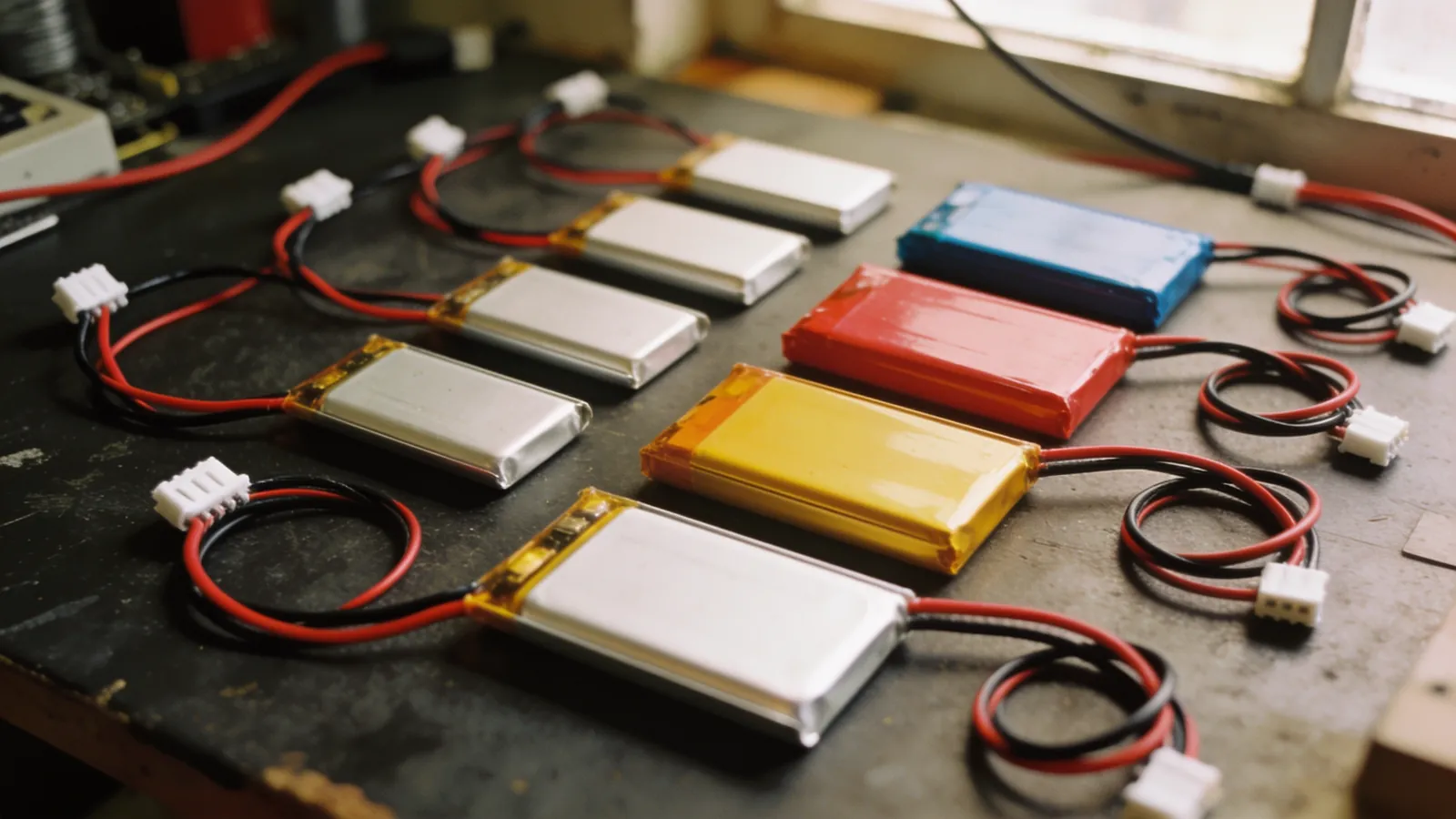
The most overlooked component in robotics projects is the battery. Teams that spend hours researching motors often choose a battery based on the “whatever’s on hand” mentality. Yet an inadequate battery can slow down even the best motor, and a LiPo battery used incorrectly poses a real fire hazard.
In this guide, I’ll explain what the numbers on LiPo batteries mean, how to choose the right one for your project, and the rules for using a battery safely and extending its lifespan.
Reading the Numbers on the Label
On a typical LiPo battery, you’ll see something like this: 3S 1300mAh 45C. There are three separate pieces of information.
S — number of cells and voltage
S stands for the number of cells connected in series. Each LiPo cell produces a nominal 3.7 V:
| Label | Nominal | Fully Charged | Discharged (lower limit) |
|---|---|---|---|
| 1S | 3.7 V | 4.2 V | 3.0 V |
| 2S | 7.4 V | 8.4 V | 6.0 V |
| 3S | 11.1 V | 12.6 V | 9.0 V |
| 4S | 14.8 V | 16.8 V | 12.0 V |
| 6S | 22.2 V | 25.2 V | 18.0 V |
The critical point here is that a fully charged battery has a voltage significantly higher than its nominal voltage. If you assume a 3S battery is “11 volts” and connect it to a circuit limited to 12 V, the 12.6 V from a freshly charged battery could overload that circuit.
mAh — Capacity
Capacity indicates how much energy a battery stores. A 1,300 mAh battery can theoretically deliver a current of 1,300 mA for one hour.
Practical calculation:
Çalışma süresi (dk) ≈ (Kapasite mAh / Ortalama akım mA) × 60 × 0,8The 0.8 factor accounts for real-world conditions: since you shouldn’t fully discharge the battery, the usable capacity is approximately 80%.
Example: Your robot draws an average of 2,000 mA, and you’re using a 1,300 mAh battery. (1,300 / 2,000) × 60 × 0.8 ≈ 31 minutes. That’s more than enough for a competition day.
C — discharge rate
This is the most commonly misunderstood value. C represents the maximum current a battery can deliver relative to its capacity:
Maksimum sürekli akım (A) = Kapasite (Ah) × C değeriA 1,300 mAh (1.3 Ah) 45C battery: 1.3 × 45 = 58.5 A.
This value must be sufficient to handle the current drawn by the motors during startup. If the C value is insufficient, the battery voltage drops under load; the robot slows down, the board reboots, and the battery overheats.
The C-rating listed on the label of cheap batteries is often exaggerated. A battery labeled 100C may actually only deliver 30C. To be on the safe side, choose a battery with a C-rating that is at least twice your required capacity.
Choosing a Battery for Your Project
Decide in three steps.
1. Motors determine the voltage
Choose an S value close to your motor’s nominal voltage. Powering a 6 V motor with 3S (12.6 V) means fast performance in the short term but burnt-out windings in the medium term. I’ve covered motor and driver compatibility in the motor selection guide.
| Motor nominal | Suitable battery |
|---|---|
| 3–6 V | 1S or 2S + regulator |
| 6–7.4 V | 2S |
| 12 V | 3S |
| 14.8 V+ | 4S |
2. Calculate the current
Add up all the loads and factor in the peak current:
Motor kalkış akımı ≈ Sürekli akımın 5–8 katıIf two motors each draw 1.5 A continuously, you may see a momentary 15–24 A during startup. The battery’s C-rate must be able to handle this.
3. Don’t forget the weight limit
In categories with a 500-gram limit, such as Mini Sumo, the battery is also part of the weight budget. A typical 2S 1000 mAh battery weighs about 60–70 grams; this accounts for 14% of the total weight.
Charging: The Complete Rules
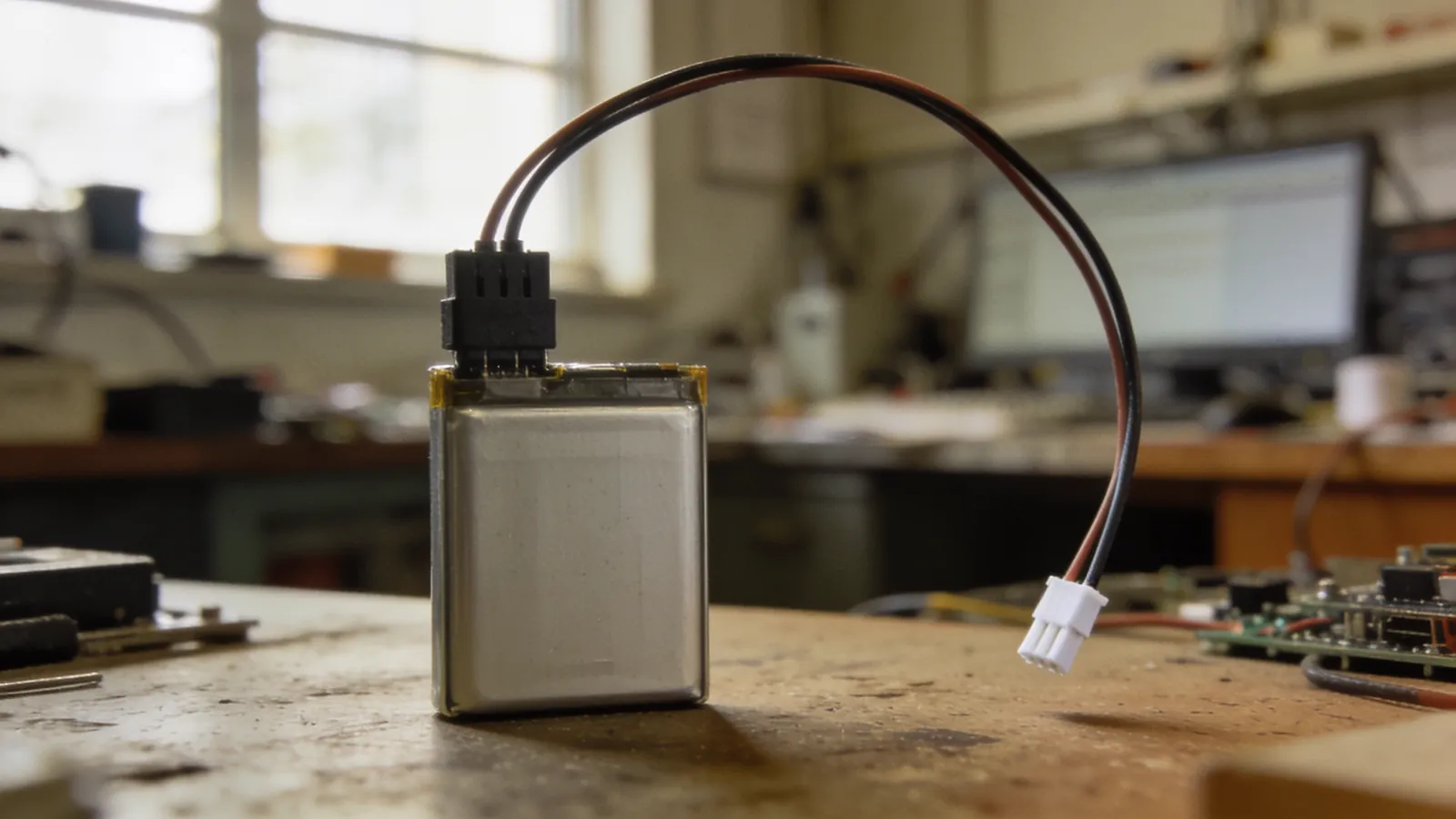
LiPo charging is based on rules, not habits. The following points are non-negotiable:
- Use only a LiPo charger. A lead-acid or NiMH charger will destroy a LiPo battery.
- Always connect the balance connector. Cells drift to different voltage levels over time; balanced charging equalizes them.
- The standard charging current is 1C. For a 1,300 mAh battery, that’s 1.3 A. Fast charging shortens the battery’s lifespan.
- Stay nearby while charging. This is the most commonly violated rule—and the one that causes the most damage.
- Charge in a fire-resistant bag. A LiPo bag is inexpensive; the alternative is a fire.
- Do not charge on flammable surfaces. Ceramic tile, a metal tray, or concrete are suitable.
Why cell balancing is important
In a 3S battery, if the cell voltages are 4.20 V / 4.20 V / 3.85 V, the total voltage appears normal, but the third cell is weak. During discharge, that cell drops to a critical level first and sustains permanent damage.
Measure the cells one by one using the balance connector. If the difference between cells exceeds 0.05 V, the battery is unbalanced and must be corrected with a balanced charge. If the difference persists, the battery has reached the end of its life.
A LiPo fire is not a normal fire; it cannot be extinguished with water and may reignite after being put out. Sand or a Class D fire extinguisher is required. The best approach is to prevent the fire from starting in the first place: do not overcharge, puncture, or short-circuit the battery.
Discharge and Low-Voltage Protection
The most damaging thing to a LiPo battery is over-discharge. Permanent capacity loss begins when a cell drops below 3.0 V; a battery below 2.5 V is generally unusable.
Use an alarm
An inexpensive “LiPo alarm” module plugs into the balance connector and emits an audible alert when the cell voltage drops below the threshold. In robot competitions, this 50-lira part can save a 500-lira battery.
Software-Based Protection
You can add a simple voltage divider to your board to monitor the battery voltage:
// 3S pil (maks 12,6 V) için gerilim bölücü: R1=100k, R2=22k
// Bölünmüş gerilim = 12,6 × 22 / 122 ≈ 2,27 V  → 3,3 V girişe güvenli

float pilGerilimi() {
  int ham = analogRead(PIL_PIN);
  float vOlculen = ham * (3.3 / 4095.0);        // ESP32, 12 bit
  return vOlculen * (122.0 / 22.0);             // bölücü oranını geri çarp
}

void pilKontrol() {
  float v = pilGerilimi();
  float hucreBasi = v / 3.0;                    // 3S

  if (hucreBasi < 3.5) {
    uyariLediYak();
  }
  if (hucreBasi < 3.3) {
    motorDur();                                  // güvenli durma
  }
}
Be mindful of board-specific differences when measuring with an ADC; the ESP32’s ADC is non-linear and requires calibration.
An End-to-End Power Budget Example
Let’s put the theory into practice. Let’s calculate the power requirements of a mini sumo robot from start to finish.
Consumers
| Component | Quantity | Continuous | Peak |
|---|---|---|---|
| Geared DC motor | 2 | 600 mA | 3,200 mA |
| Control board | 1 | 60 mA | 80 mA |
| ToF distance sensor | 5 | 20 mA | 25 mA |
| Floor sensor | 4 | 25 mA | 25 mA |
| Start receiver | 1 | 10 mA | 10 mA |
Totals:
Sürekli = (2 × 600) + 60 + (5 × 20) + (4 × 25) + 10 = 1.470 mA ≈ 1,5 A
Tepe    = (2 × 3200) + 80 + (5 × 25) + (4 × 25) + 10 = 6.715 mA ≈ 6,7 A
Battery Selection
Since the motors have a nominal voltage of 7.4 V, a 2S battery is required. For capacity and C-rate:
- C requirement: Peak current is 6.7 A. With a safety margin, it must be able to handle 13.4 A.
- C required for an 850 mAh battery: 13.4 / 0.85 = 16C
- C required for a 1,300 mAh battery: 13.4 / 1.3 = 11C
You can enter your robot’s specifications below to perform the same calculation instantly. Lowering the C value to see what goes wrong is the quickest way to understand why this is important.
2S batteries rated at 25C or higher, which are widely available on the market, easily meet this requirement. As for capacity:
(1300 mAh / 1500 mA) × 60 × 0,8 ≈ 41 dakika sürekli çalışmaIf a match lasts 3 minutes, you can play dozens of matches on a single battery. Still, bring a spare battery—the issue isn’t capacity, but not having time to recharge between matches.
Weight Control
A 2S 1300 mAh battery weighs approximately 75 grams. At the 500-gram limit, this accounts for 15%. If you’re tight on weight, you can go down to 850 mAh (about 50 g); the calculation shows that the capacity remains more than sufficient.
Choosing a Charger
This is just as important as the battery itself, yet it’s a topic that’s almost never discussed. Cheap chargers either don’t balance the battery properly or do it incorrectly.
Features to Look For
| Feature | Why It’s Necessary |
|---|---|
| Balanced Charging | Equalizes cells individually — required |
| Storage mode | Charges the battery to 3.8 V, extends its lifespan |
| Adjustable current | Required for 1C charging |
| Cell voltage indicator | Detects imbalances early |
| Discharge function | To reduce to storage level |
| Chemistry selection | LiPo, Li-ion, LiFe, NiMH differentiation |
A device offering these six features is several times more expensive than a simple single-cell charger but remains well below the cost of replacing the battery.
Charging routine
- Visually inspect the battery: check for swelling, holes, or tears.
- Read the cell voltages. Be cautious if the difference between them exceeds 0.05 V.
- Select the correct chemistry and the correct S value. Choosing the wrong S value is the most dangerous mistake.
- Set the current to 1C.
- Place the battery in a fireproof bag and set it on a non-flammable surface.
- Stay in the room throughout the charging process.
Storage: The only rule that doubles battery life
A LiPo battery ages rapidly when left fully charged. If it won’t be used for an extended period, discharge it to 3.8–3.85 V per cell. The “Storage” mode on chargers does exactly that.
| Status | Cell Voltage | Long-term effect |
|---|---|---|
| Storage at full charge | 4.20 V | Rapid aging, risk of swelling |
| Storage voltage | 3.80–3.85 V | Longest lifespan |
| Discharged storage | <3.3 V | Permanent capacity loss |
Other storage guidelines:
- Store in a cool place (ideally 15–25 °C). A hot car trunk is the worst place.
- Store in a non-flammable container or metal box.
- Check the voltage once a month.
- Prevent the connectors from touching each other.
What to do if a battery swells
Swelling is an irreversible chemical degradation. What to do:
- Stop using and charging the battery immediately.
- Place it in a non-flammable container in an open area to ensure safety.
- Place it in saltwater (about 2 tablespoons of salt per liter) and let it sit for a few days; this will fully discharge the battery.
- Once the voltage has dropped to zero, take it to a battery recycling center.
- Never throw it in the regular trash, puncture it, or burn it.
Alternatives
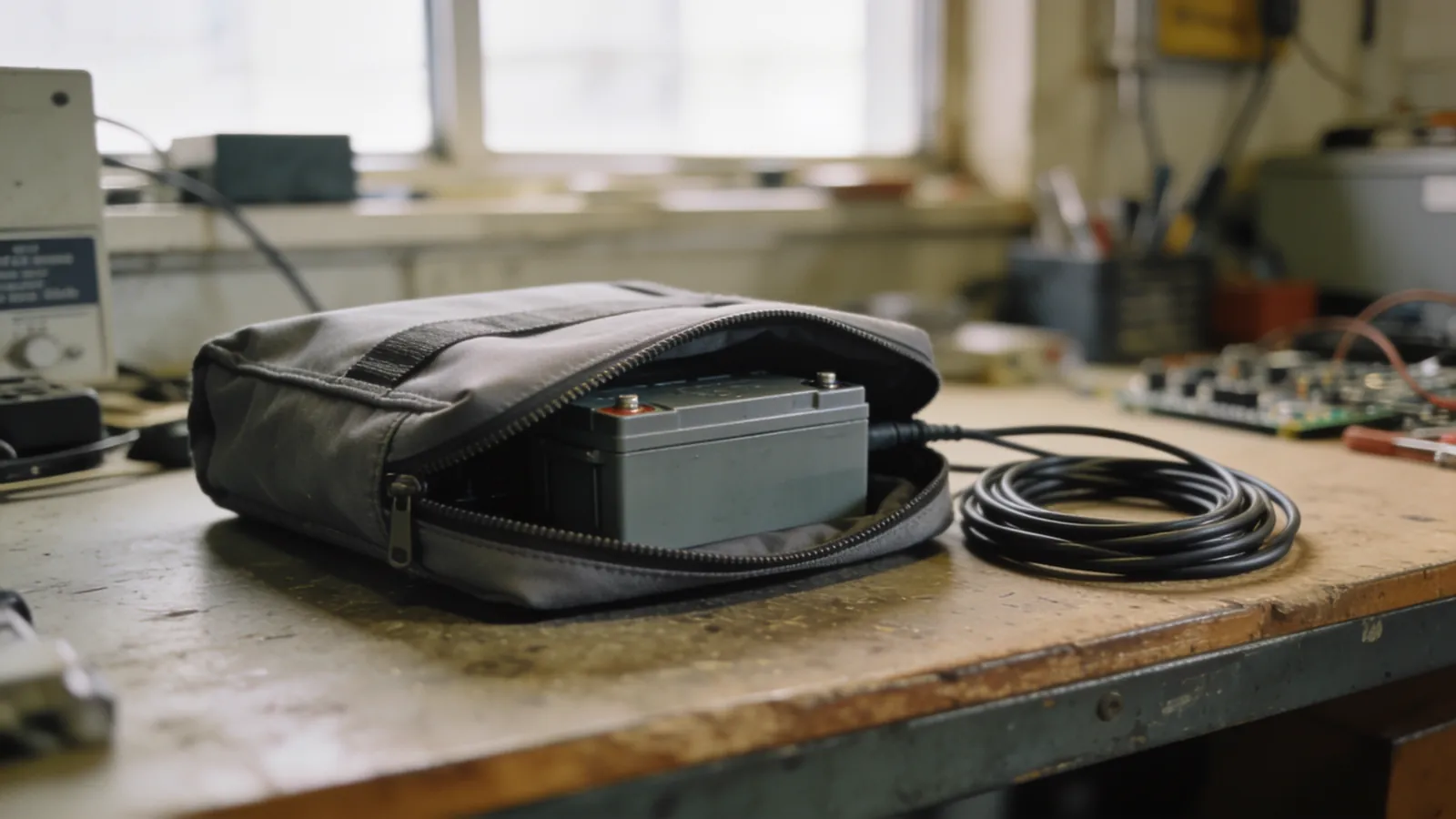
Not every project requires LiPo:
- 18650 Li-ion: Safer, longer-lasting, and heavier. A good choice for projects that don’t require high current.
- LiFePO4: Very safe and long-lasting, with a cell voltage of 3.2 V. Low energy density.
- NiMH: Outdated technology but very forgiving. Still a reasonable choice for student projects.
- LiPo: Highest power density. The standard for competition robots—but only if you follow the rules.
Summary checklist
- Select the voltage based on your motor, taking the fully charged value into account.
- The C-rate should be at least twice your peak current requirement.
- Always charge in a balanced manner, at a 1C current.
- Never leave the battery charging unattended; use a fire-resistant bag.
- Do not let the voltage drop below 3.3 V per cell; set up an alarm or software protection.
- If you won’t be using it for a long time, bring it to storage voltage.
- Do not use a swollen battery; dispose of it safely.
When the power system is set up correctly, the rest of the robot behaves much more predictably. Add battery preparation to your competition checklist before heading to the competition.
Frequently asked questions
LiPo pilde S ne anlama gelir?
S, seri bağlı hücre sayısıdır ve gerilimi belirler. Her hücre nominal 3,7 V’tur. 2S = 7,4 V, 3S = 11,1 V, 4S = 14,8 V. Tam dolu bir hücre 4,2 V olduğundan 3S pil şarj çıkışında 12,6 V ölçer — bu normaldir.
C değeri nedir, neden önemli?
C, pilin kapasitesine göre güvenle verebileceği maksimum akımı gösterir. Maksimum akım = Kapasite (Ah) × C. Örneğin 1300 mAh 25C bir pil, 1,3 × 25 = 32,5 A verebilir. C değeri yetersizse pil ısınır, şişer ve gerilimi yük altında çöker.
LiPo pil kaç volta kadar boşaltılabilir?
Hücre başına 3,0 V mutlak alt sınırdır; pratikte 3,3–3,5 V’ta durmak pilin ömrünü belirgin şekilde uzatır. 3,0 V altına inen hücreler kalıcı kapasite kaybeder ve şarj edilmesi tehlikeli hale gelebilir.
LiPo pil nasıl saklanmalı?
Ne dolu ne boş: hücre başına 3,8–3,85 V (saklama gerilimi) seviyesinde. Çoğu şarj cihazında “Storage” modu bunu otomatik yapar. Tam dolu bırakılan bir LiPo birkaç haftada belirgin kapasite kaybeder ve şişme riski artar.
Şişmiş LiPo pil kullanılır mı?
Hayır, kesinlikle. Şişme, hücre içinde gaz oluştuğunu gösterir ve geri döndürülemez. Şişmiş pili şarj etmeyin, delmeyin, çöpe atmayın. Tuzlu suda birkaç gün deşarj edip atık toplama noktalarına teslim edin.
Comments
0No comments yet. Be the first to comment!