One of the things I noticed most clearly when developing a mini-sumo robot was that sensor selection directly determines performance. How fast, how accurate and how stable the robot perceives the opponent affects its entire behavior on the field. Therefore, it is necessary to evaluate the sensor selection not only at the "is it working" level, but also completely performance-oriented. Based on my own experience, I have examined ultrasonic and IR sensors in detail and i clarified the differences between them.
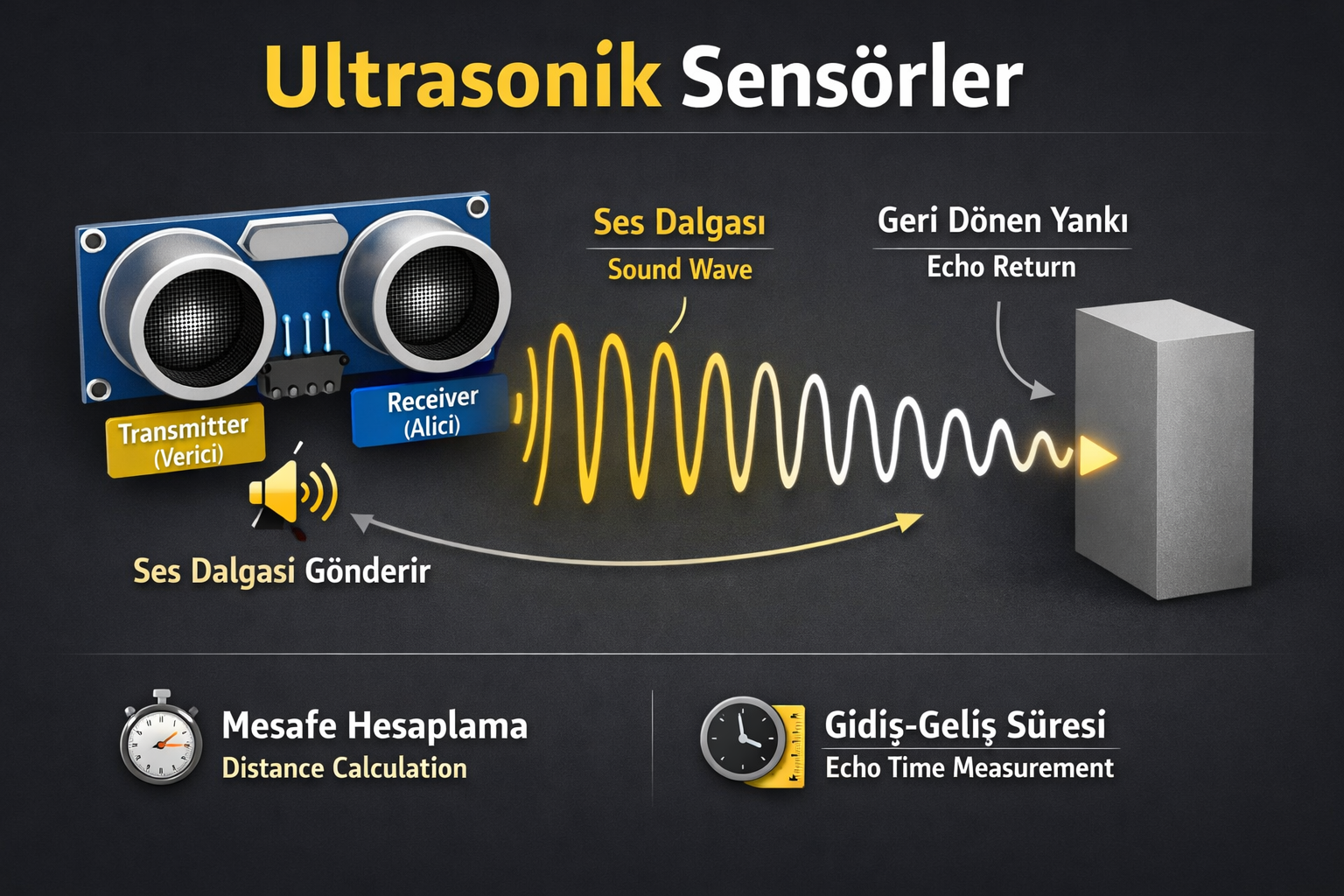
1. Ultrasonic Sensors (Ultrasonic)
When Ifirst started working with ultrasonic sensors, the most striking thing was the clarity of the distance measurement. The system works quite simply: the sensor sends out a sound wave at a high frequency (usually around 40 kHz), which is transmitted to a surface crashes back and the distance is calculated based on the time elapsed.
Operating Logic
- Sensor sends out sound wave The
- wave hits the object and returns
- Distance is calculated according to round trip time
Benefits (My Experience)
- Distance measurement is really accurate, gives accurate results at cm level
- Black or white surface does not matter
- It is a great advantage that it is not affected by ambient light
- Opponent's you can get the distance directly numerically
Disadvantages (I Encountered in the Field)
- Response time is slow Does
- not sometimes detect small or narrow surfaces
- Echo errors may occur in the confined space There
- is a conflict problem when using more than one sensor
Especially in fast systems such as mini sumo, this delay was the biggest problem. The sensor measures correctly, but it measures late.
<p class= "ql-align-center" >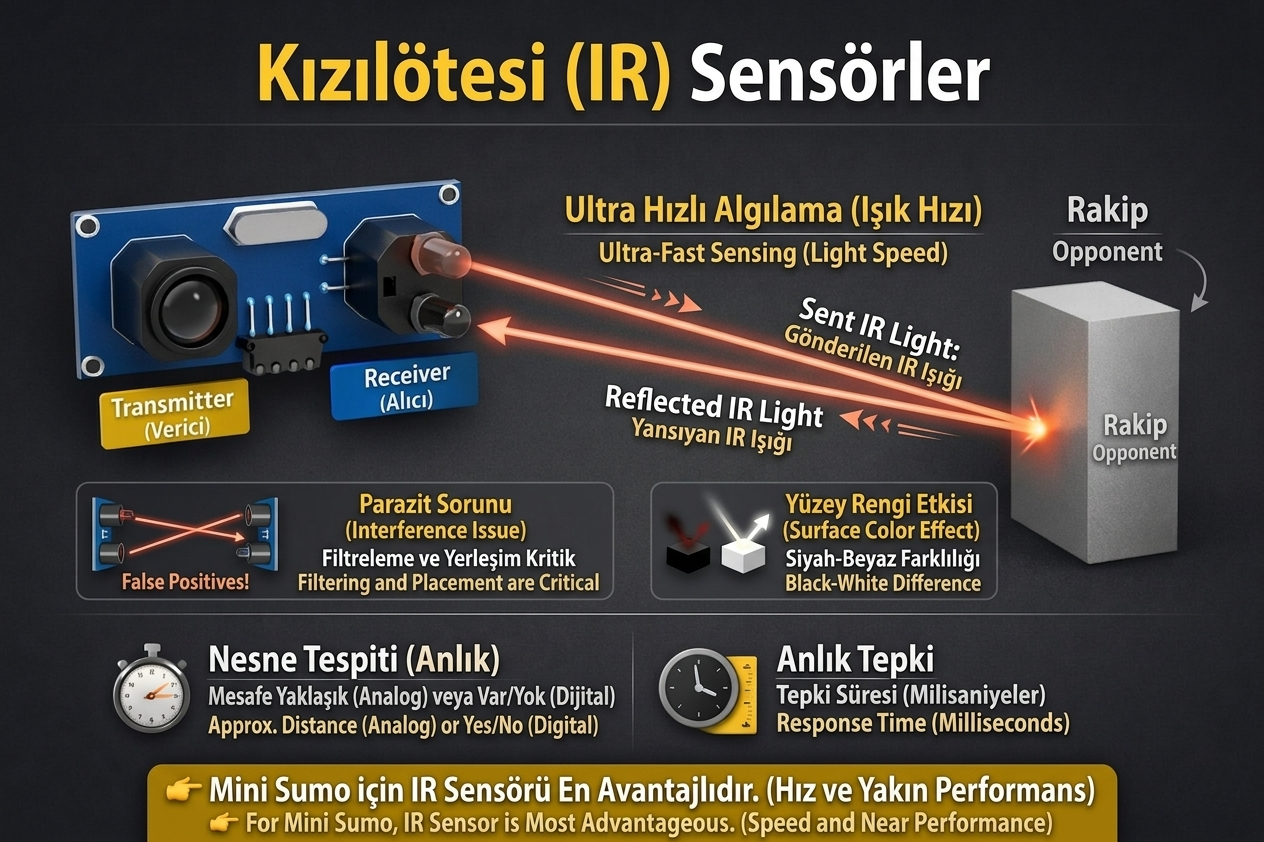
2. IR (Infrared) Sensors
When I switched to IR sensors, I immediately felt the difference. The system works much faster. The IR led sends a light, the reflected light returns to the receiver and detection is made accordingly.
Operating Logic
- Sends IR LED light
- Light is reflected from the surface
- If it reaches the buyer object is detected
Advantages (Own Use)
- Response time is too fast
- Easy to place as it is small and light
- Highly successful at close range
- Power consumption low
- Simple to process on the code side
The feature that worked best for me in the mini-sumo was clearly speed.
Disadvantages
Can- be affected by ambient light
- Performance decreases on black surfaces
- Distance information is not as clear as ultrasonic
- The same sensors can affect each other
Especially when I used the same brand of sensors, I encountered the interference problem seriously.
3. Comparison (What I See in Practice)
- Ultrasonic → is correct but slow
- IR → fast but less sensitive
I saw clearly on the field that what matters in mini-sumo is not “accuracy” but “timing”. Even millisecond delays result in changes.
4. Critical Technical Details
IR Sensor Interference
When using the same type of IR sensors side by side:
- Sensors detect light emitted by each other
- Incorrect triggers occurred
To resolve this:
- I placed the sensors at an angle
- I applied filtering in the software
- In some cases I activated the sensors sequentially
Without this optimization, the IR system is efficient does not work.
Ultrasonic Delay
In themeasurements, I saw clearly:
- Delay between 20-50 ms occurs in ultrasonic sensors
This period shall be:
- Small on paper
- But mini-sumoda is critical
opponent changes position until the robot reacts.
The Truth About Mini Sumo
On the mini-sumo pitch:
- Robots are moving too fast
- Decisions are made instantly
Therefore:
👉 It's not enough that the sensor is just right
👉 It also needs to be very fast
5. Conclusion (My Decision)
As a result of my tests, I have reached the following:
- Ultrasonic sensors are technically more accurate
- But it is insufficient in terms of speed
- IR sensors:
- Faster
- More practical
- Better suited to the racing environment
👉 That's why mini sumo it is more advantageous to use IR sensors in robots.
6. Professional Approach
System where I got the best performance:
- IR sensors on the front (instantaneous response)
- Ultrasonic as support if necessary
But in terms of pure competition:
👉 Correctly placed and well optimized IR sensor system works best
Comments
0No comments yet. Be the first to comment!